The Script
A seventh-century alphabet built for a spoken language it no longer quite matches — and why the mismatch itself became part of the record.
The writing system was devised in the seventh century under Songtsen Gampo, traditionally credited to Thonmi Sambhota, and was built for a language it fitted better then than now.
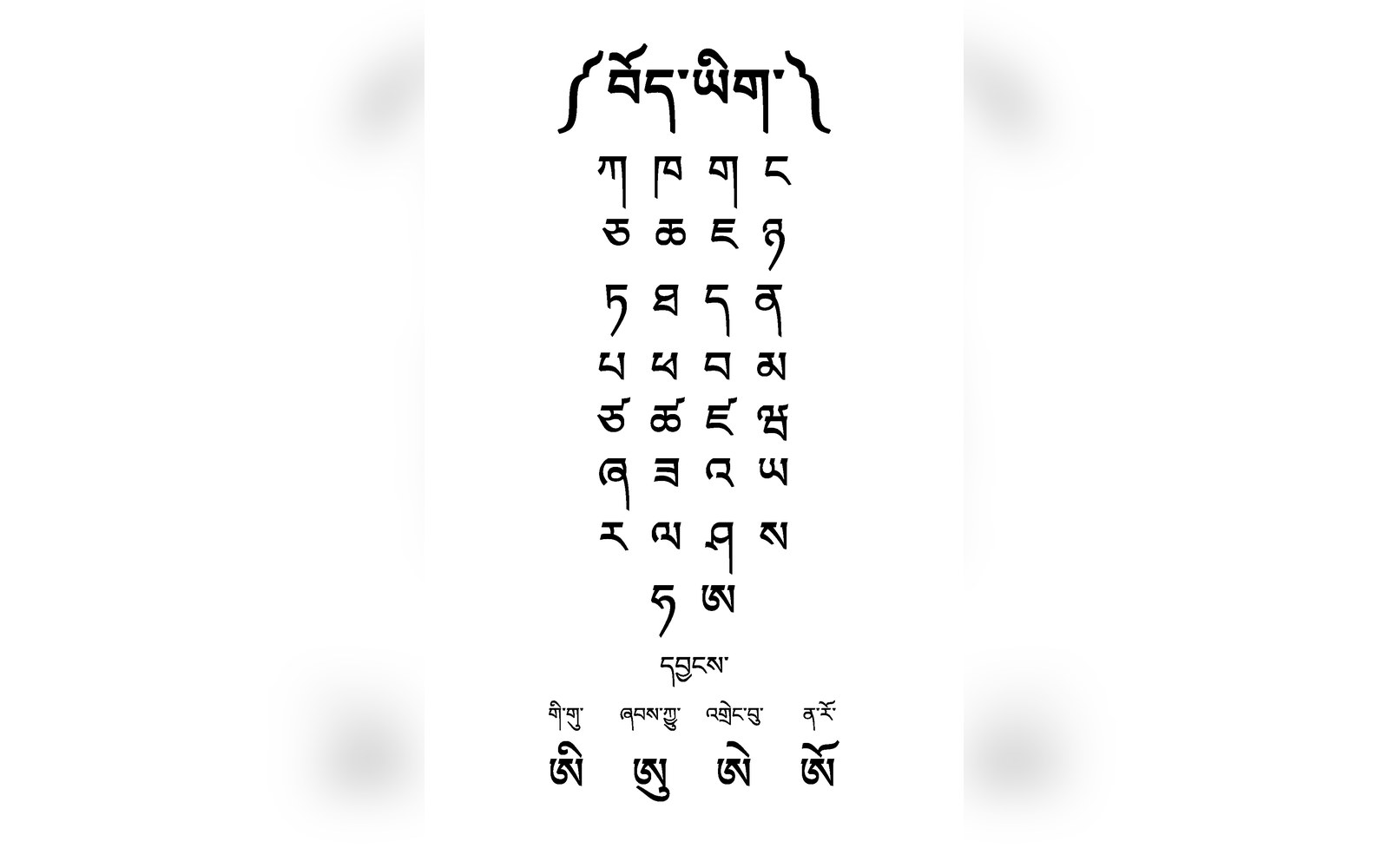
Prefix consonant: precedes the root, silent in modern speech but etymologically significantPhoto: Tibetan Varnamala · Wikimedia Commons
01Origin and Design
The traditional account is firm on the date and the name: in the reign of Songtsen Gampo (c.
617–650 CE), a minister and scholar named Thonmi Sambhota was sent to the Indian subcontinent to study existing writing systems, and returned with a script adapted to the sounds of the Tibetan language. Whether that embassy was to Kashmir, to a Gupta-influenced court, or to some other centre of learning, the tradition does not agree on — but the structural evidence in the script itself points clearly toward an Indic source. Tibetan letters derive from a Brahmic ancestor, almost certainly a North Indian variety of the seventh century, and the adaptation was thorough enough to treat Tibetan phonology as a first-class engineering problem rather than an afterthought.
The result is an abugida — a writing system in which consonants carry an inherent vowel, and other vowels are marked by diacritic signs written above or below the base letter.
Tibetan adds a further complication that Indic scripts do not share to the same degree: it stacks consonants. A syllable may carry a prefix letter, a superscript letter above the root, a root letter itself, a subscript letter below, and a suffix. In seventh-century speech, most of these positions corresponded to audible sounds. The script was, at its creation, a precise phonetic notation — a fact that the Old Tibetan documents from sealed cave deposits have since confirmed in remarkable detail.
02The Gap Between Letter and Sound
Spoken Tibetan moved on. Written Tibetan did not — at least not in its orthography. The spelling system was codified and then deliberately conserved, partly because the canon of religious and literary texts that accumulated in manuscript and later in woodblock print depended on a stable, legible standard. Prefixes that once represented real sounds became silent. Superscript and subscript consonants that once modified initial articulation collapsed into tonal distinctions in the modern spoken registers, or disappeared entirely. The Lhasa dialect today pronounces a substantial number of stacked consonant clusters as single sounds accompanied by tonal contour — information that is present in the spelling only if you know the mapping.
This drift produced what linguists call a historical orthography: the letters record what was said in the seventh century with a fidelity that, paradoxically, makes them invaluable for reconstructing earlier stages of the language. Scholars at institutions such as the International Dunhuang Project have used Old Tibetan manuscripts — some of them texts without any living reading tradition — to work backward from spelling to probable early pronunciation, comparing Tibetan with its Tibeto-Burman relatives to test hypotheses. The spelling that seems merely conservative to a modern reader is, to a historical linguist, a primary source.
The letter stack — how a syllable is built
| Prefix consonant | precedes the root, silent in modern speech but etymologically significant |
| Superscript | written above the root letter, originally modified the initial sound |
| Root consonant | the base letter, the structural centre of the syllable |
| Subscript | written below the root, historically a distinct consonant element |
| Suffix | follows the root, marks grammatical function or phonological closure |
| The same stacking logic governs both uchen (formal) and umê (cursive) hands |
03Letterforms and Materials
The script comes in two main forms that are genuinely distinct in character, though related in underlying letterform.
Uchen — which translates roughly as "with head" — carries a horizontal stroke across the top of each letter, giving it the capped, formal appearance used for manuscripts, inscriptions, and printed texts. It is the monumental and liturgical hand, incised in stone stelae, laid out in the regular columns of a woodblock page, painted in the proportioned compositions that governed high-grade manuscript production. Umê — "without head" — drops the headstroke and becomes a cursive, faster form used for everyday writing, correspondence, and marginalia. The two registers coexisted in the same culture the way roman type and running hand coexisted in medieval Europe: function and context determined the choice.
Both forms were produced with tools that left marks in their letterforms.
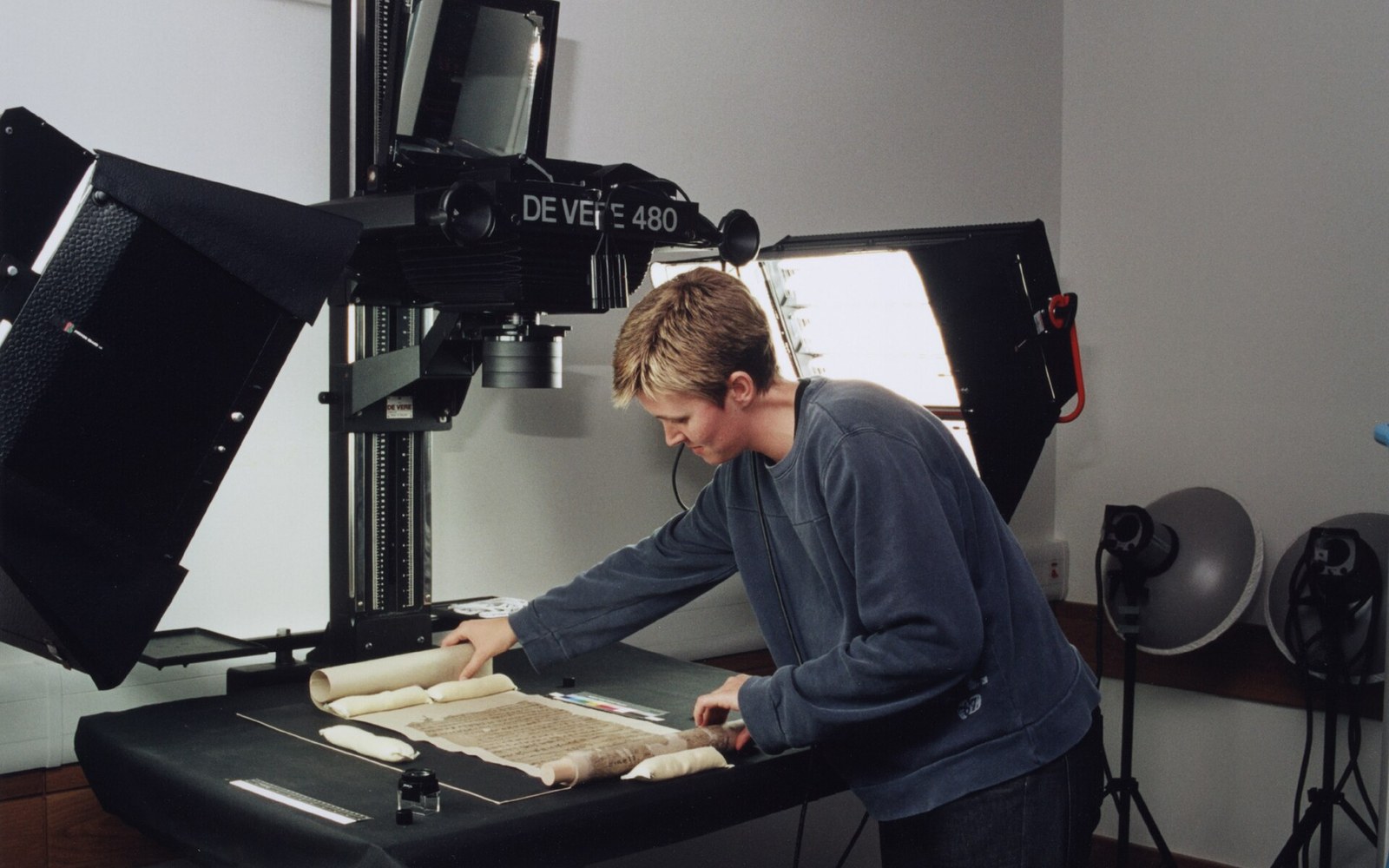
Mineral pigments ground to consistent particle sizes were used for the most valued manuscripts — gold lettering on black-lacquered paper, silver on deep indigo — while carbon and vegetable inks covered the everyday range. The writing surface itself was part of the material system: Tibetan paper, manufactured from the root of the toxic shrub Stellera chamaejasme, is dense, resistant to insects, and carries ink with a surface that preserves definition over centuries. The physical longevity of so much Tibetan manuscript material is inseparable from the properties of that paper.
The tools for writing on stone are different again.
The pillar inscriptions that survive from the imperial period — several still standing in Lhasa, at the foot of the Potala hill and near the Jokhang — were incised in uchen into dolerite columns. These stelae are among the earliest surviving written records in Tibetan and carry diplomatic and commemorative texts, including an account of a treaty with a neighbouring power dated by internal evidence to 821–822 CE. They offer the palaeographer a fixed point: a dated inscription in stone is a control against which manuscript hands can be calibrated.
04A Script Beyond the Plateau
Tibetan script, once established, did not remain confined to the plateau.
It spread as the medium of a textual culture rather than of a single ethnicity, carried by manuscript traditions into Ladakh, Sikkim, Bhutan, and the highland communities of the Himalayan rim — a distribution that followed the transmission of texts rather than the movement of armies. Later adaptations of the Tibetan script were used for Dzongkha, the national language of Bhutan, and for certain Himalayan minority languages that never developed independent writing systems. The script also became the technical template for the Phags-pa script devised in the thirteenth century under the Mongol court — an invention attributed to the scholar Drogön Chögyal Phagpa, who based its letterforms explicitly on Tibetan.
Meanwhile, the plateau itself generated an enormous volume of manuscript material that preserved the script's archaic forms alongside medieval and early modern developments.
When Aurel Stein and Paul Pelliot reached the sealed library cave at Dunhuang in 1907 and 1908, they found among the tens of thousands of documents a substantial corpus in Tibetan — texts predating the orthographic conservatism of the later period, in a hand close enough to early phonology to reopen questions about the script's founding moment. Those documents, now held between the British Library and the Bibliothèque nationale de France among other institutions, remain central to any account of what Thonmi Sambhota's creation actually sounded like when it was new.
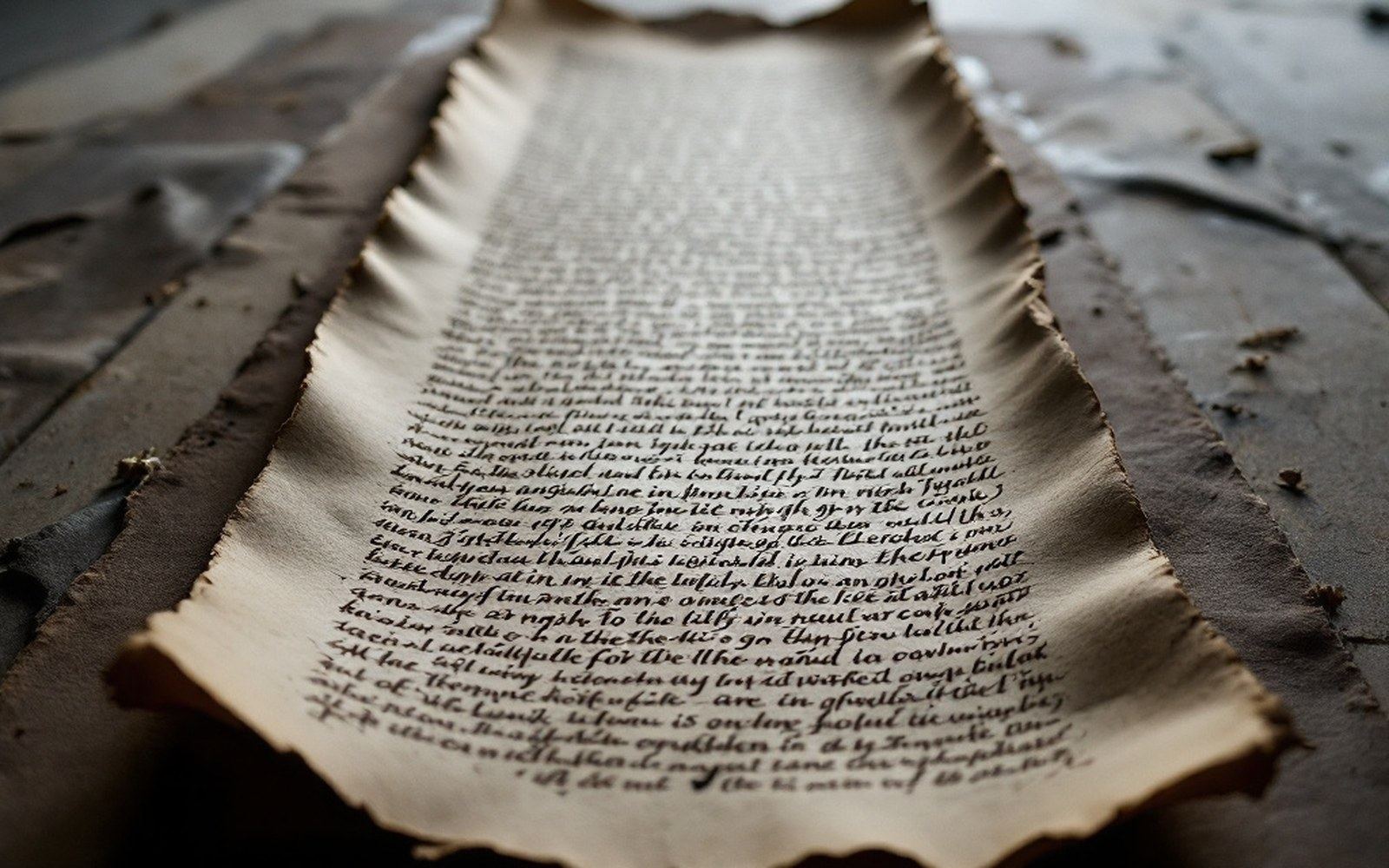
The language of those documents differs from the modern written form in spelling and grammar, which is how the manuscripts are dated. Read the entryProTibet picture library
The script, in the end, is not a neutral conduit for language.
It is itself an artifact — a seventh-century decision about which sounds matter and how they combine, preserved in letterform through a millennium of copying, carving and printing, and still legible to a literate Tibetan today in a way that no phonetic transcription of the spoken language could be. The mismatch between the letters and the modern mouth is the measure of how much changed. The fact that the letters can still be read is the measure of how much held.
Chronology
- c. 617–650 CEReign of Songtsen Gampo; traditional date of the script's creation
- 821–822 CETreaty pillar inscription at Lhasa, one of the earliest dated Tibetan texts in stone
- 13th centuryPhags-pa script developed from Tibetan letterforms for use at the Mongol court
- 1907–1908Stein and Pelliot reach Dunhuang; Tibetan manuscripts enter international collections
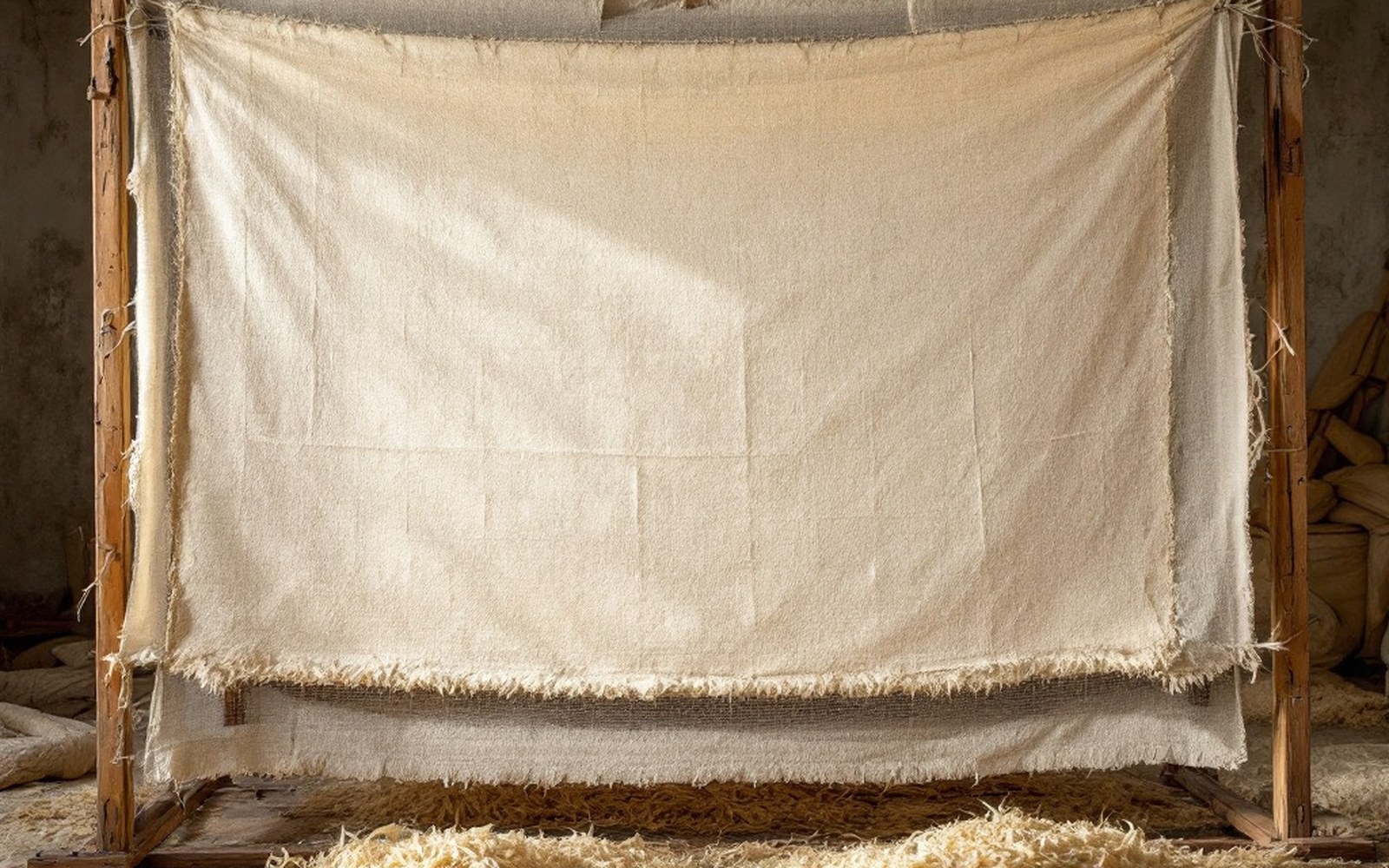
Paper made from a toxic shrub root resists insects, which is a large part of why so much survived. Read the entryProTibet picture library
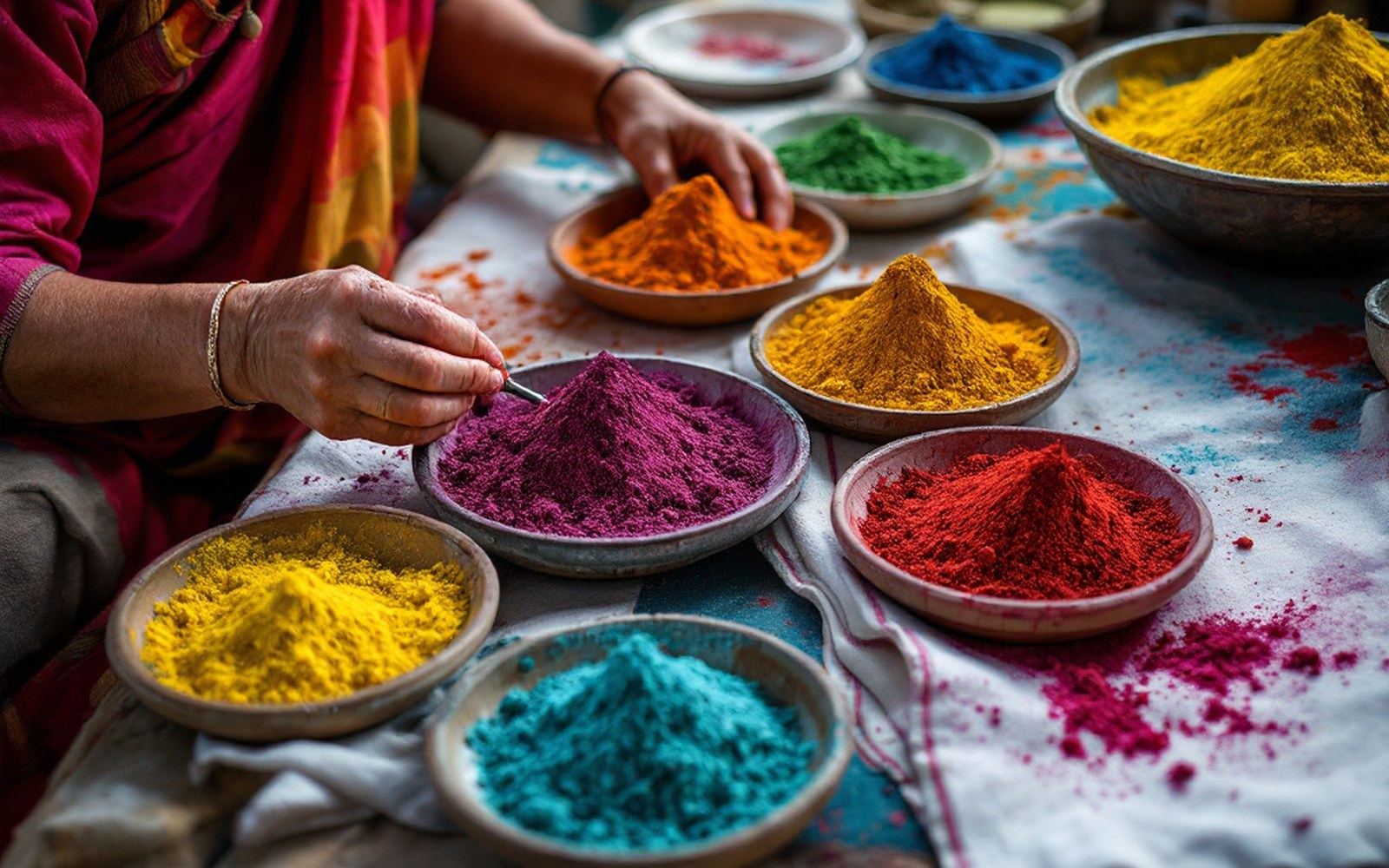
The colours are stones before they are paint — azurite, malachite, cinnabar and orpiment, ground and bound in hide glue.ProTibet picture library
Lhasa at 29.65°N 91.12°E — the position the route surveys fixed, with the other places named across the site.
- A place an entry names — the pin opens that entry
- Graticule at 5° of longitude, 3° of latitude
- National outlines: China, India, Nepal, Bhutan