Weaving
Narrow cloth, joined in strips: the logic of the loom determines the pattern.
Backstrap and frame looms produce narrow cloth that is joined in strips, which is why the patterning runs the way it does.
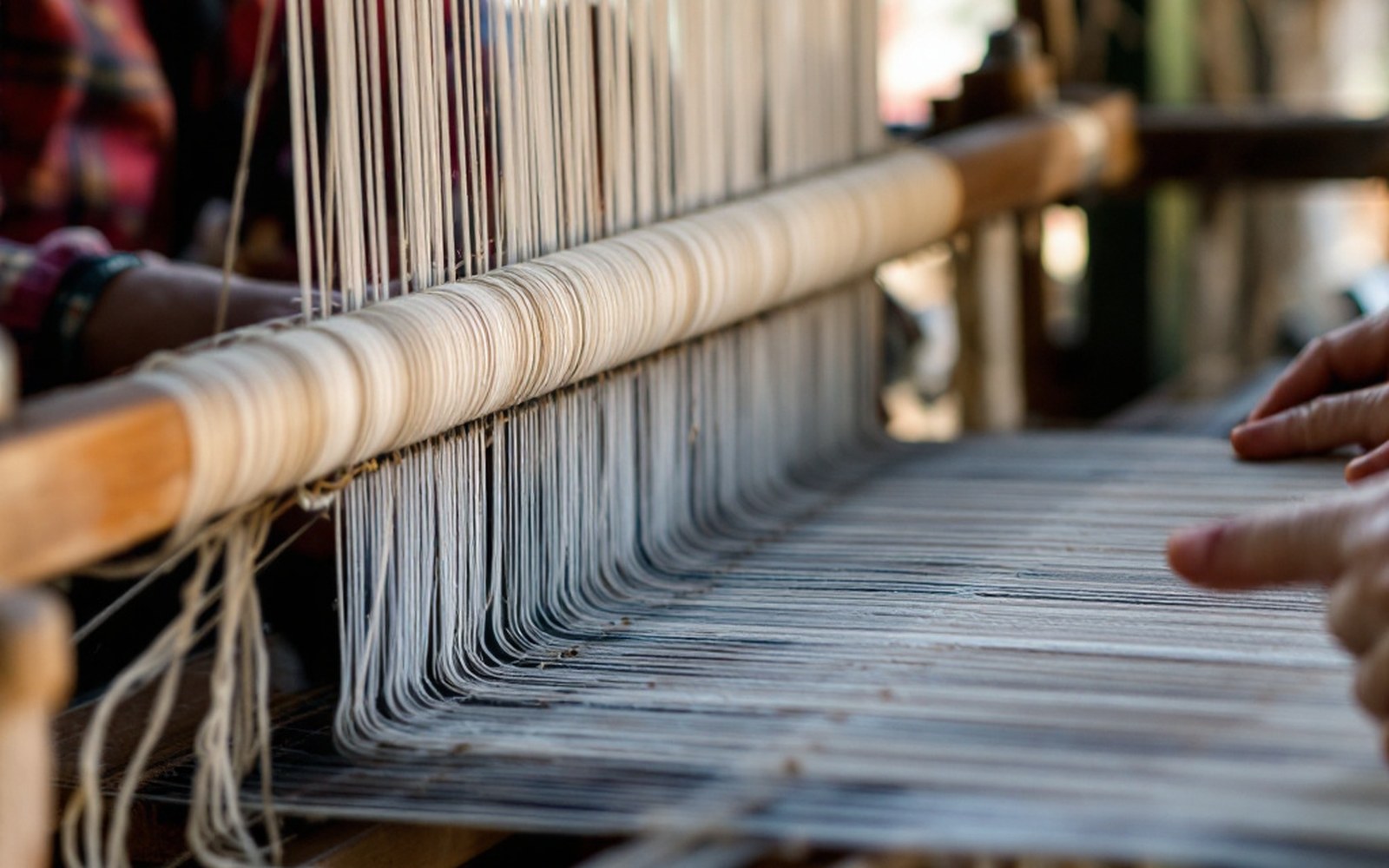
Backstrap loom: portable, narrow web; tension held by the weaver's body weightProTibet picture library
01The Loom and the Width
Two loom types produced almost all traditional Tibetan cloth.
The backstrap loom — a strap anchored at the weaver's lower back, tension held by leaning — is portable and needs no fixed frame, which suited a pastoral economy where households moved. The frame loom, larger and fixed, belonged to settled communities in the agricultural valleys of the Yarlung Tsangpo and around Gyantse (28.9°N, 89.6°E), which became one of the plateau's acknowledged centres of fine weaving. Both types share a structural consequence: they produce a narrow web, typically around forty to fifty centimetres wide. Any garment or hanging wider than that is made from multiple strips sewn selectively together.
That join is not hidden — it is built into the design logic.
Weavers calculate their patterns so that seams fall at compositional boundaries, colour bands align across the join, and the overall surface reads as coherent. A thangka backing, a chuba (the full-length wrap garment), a tent panel woven from yak hair: all are strip constructions, and the strip width is the base unit from which the pattern is scaled.

Ground azurite, malachite, cinnabar and orpiment, bound in animal glue — the colours are stones before they are paint. Read the entryProTibet picture library
02Fibre, Twist and Surface
Fibre choice was governed by altitude and availability.
Wool from sheep — including the fine-fleeced animals raised in the Chang Tang (roughly 31–35°N, 83–90°E) — was the dominant weft material. Yak fibre, coarser but exceptionally warm, was reserved for heavier cloth and rope. In a small number of contexts, particularly in textiles that passed through trade networks linking the plateau to Ladakh and the Kathmandu Valley, cotton was used as warp, giving a firm structure on which patterned wool wefts could float.
Spin direction matters in weave structure: Tibetan spinners traditionally used a drop spindle to produce an S-twist yarn, and the combination of twist direction and weave structure determines how a finished surface catches light. Twill weaves — in which weft threads float over two or more warps — produce a diagonal rib that is both supple and dense, well suited to the plateau's cold. The woollen cloth called nambu, a plain-weave woollen with a characteristically muted stripe, was woven in strips and made into everyday garments across much of the Tibetan-speaking world.
Materials and method
| Backstrap loom | portable, narrow web; tension held by the weaver's body weight |
| Frame loom | fixed, community-based, associated with settled valley towns |
| Nambu | plain-weave woollen striped cloth, the most common everyday textile |
| S-twist yarn | spin direction produced on a drop spindle; affects surface light and weave structure |
| Twill weave | weft floats over multiple warps; supple, dense, warm |
| Knotted pile | symmetrical cut-pile knot, short pile, geometric field patterns; centred on Gyantse and Shigatse |
03Pattern as Geography
The decorative grammar of Tibetan weaving is closely tied to region.
Gyantse and Shigatse (29.3°N, 88.9°E) produced knotted pile rugs — a form that likely arrived from Central Asian traditions somewhere in the first millennium — with bold geometric fields: swastikas, cloud scrolls and fret patterns rendered in a vocabulary shared with textile traditions to the northwest. The knot used is a symmetrical cut-pile knot worked in offset rows, and pile height was kept short relative to Persian or Anatolian equivalents, giving a dense, flat-faced surface. Tibetan rugs from these regions show colour blocking rather than gradated shading, a choice enforced partly by the loom width and strip-join method, partly by a palette built from plant and mineral dyes — madder for reds, indigo for blue-black, and local plant sources for yellow.
Warp-faced bands, woven on a small backstrap loom, served as belt cloth, apron borders and bag edging.
These narrow pieces — sometimes barely eight centimetres wide — carry the densest patterning of any Tibetan weave form, because in a warp-faced structure the pattern is entirely in the warp and the weaver controls it by hand-picking. Such bands from the Yarlung Tsangpo valley show continuous geometric interlacing that has close analogues in belt-weaving traditions across the Himalayan arc, suggesting exchange of pattern knowledge along trade and pastoral routes long before any documented record.
The seam between two strips of nambu is, in the end, where material logic and aesthetic decision meet: the weaver's choice about where to cut the pattern and how to match it across the join is as deliberate as any drawn design.
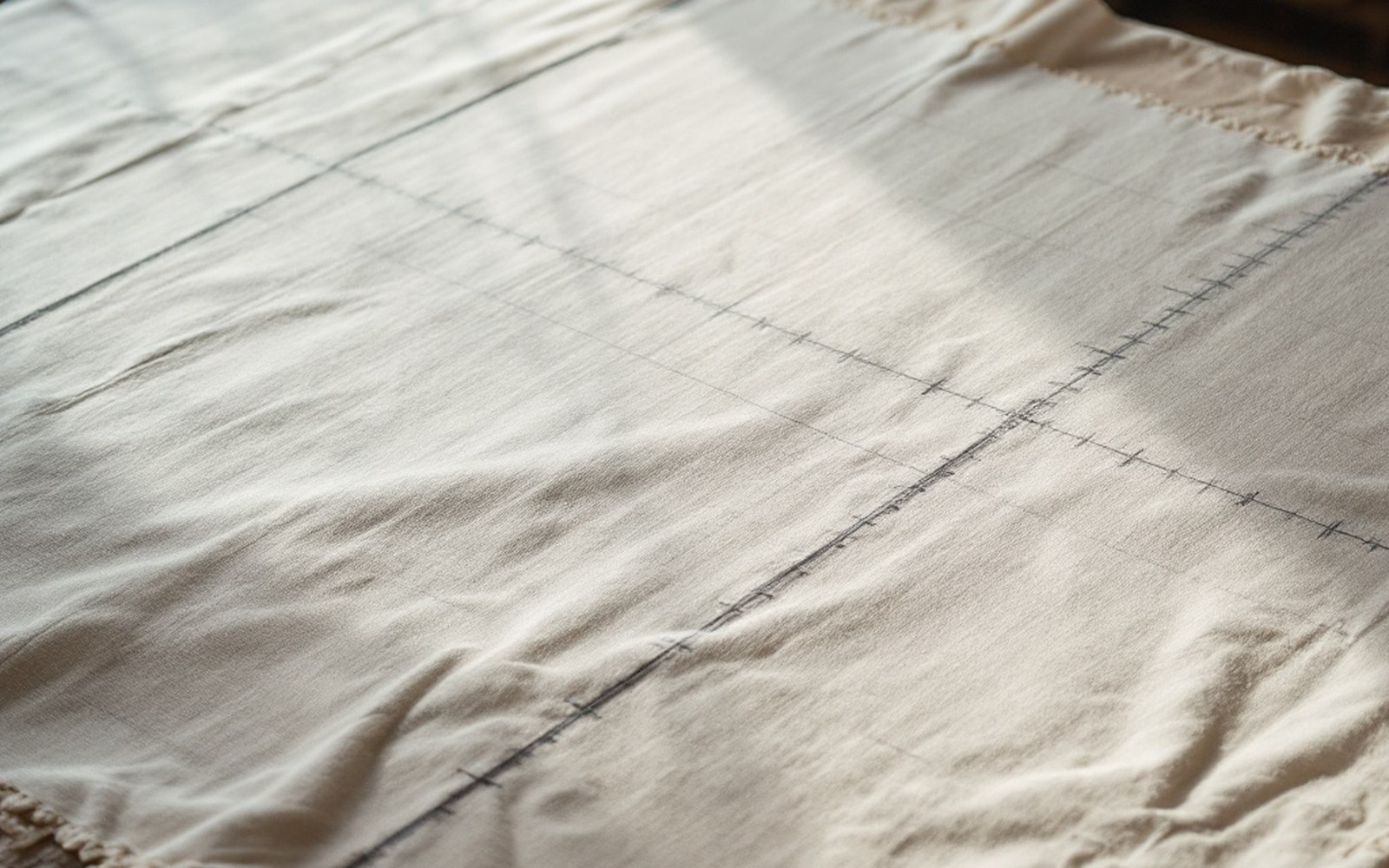
A painted figure is set out on a ruled proportional grid before any colour is laid, so the drawing is a measurement rather than a sketch. Read the entryProTibet picture library
Key dimensions
- Strip width: typically 40–50 cm, governing all seam-based pattern construction
- Warp-faced bands: as narrow as ~8 cm, highest patterning density of any Tibetan weave form

Text was printed from carved blocks onto long loose leaves, one block to a page, and the blocks were kept. Read the entryProTibet picture library
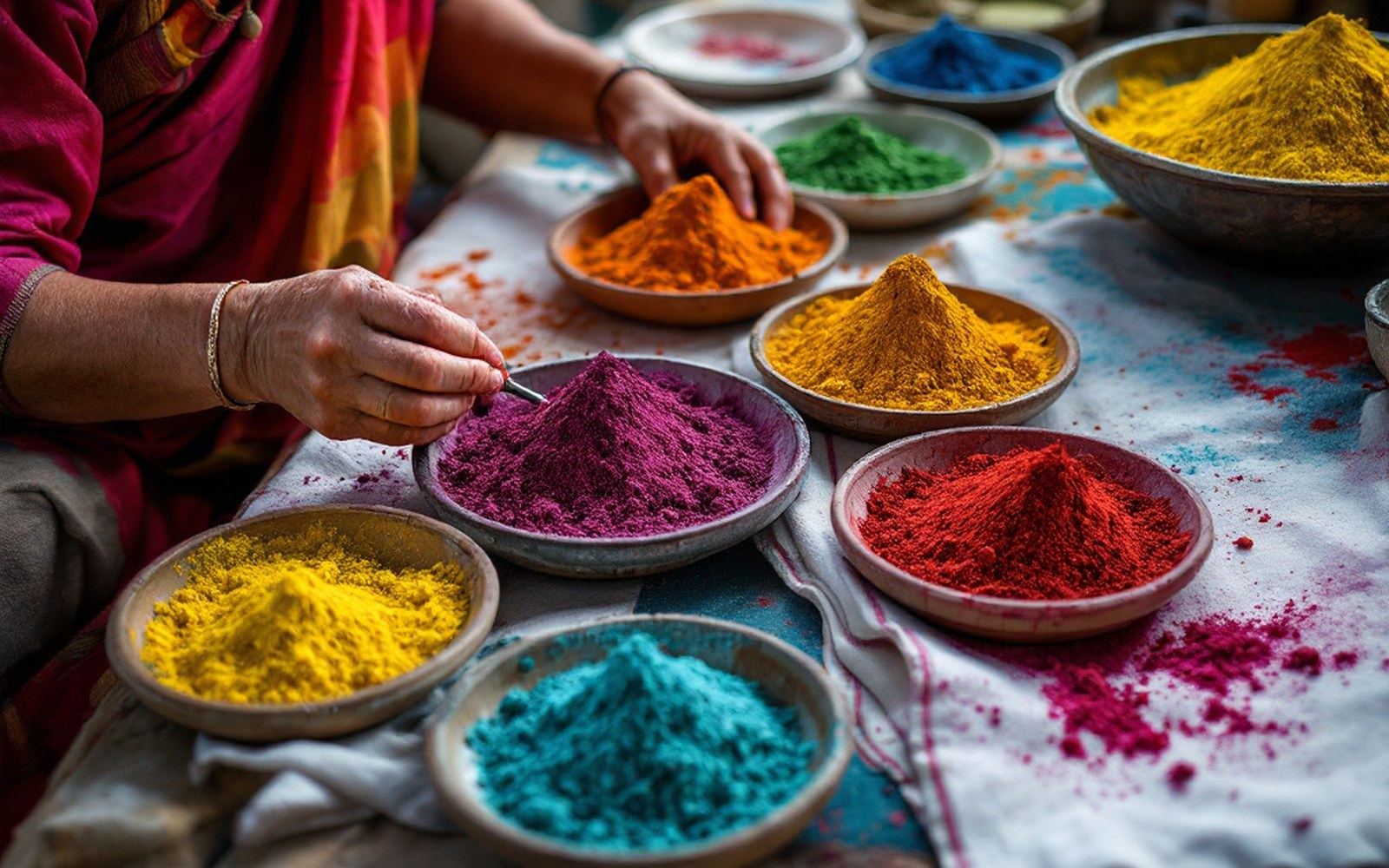
The colours are stones before they are paint — azurite, malachite, cinnabar and orpiment, ground and bound in hide glue.ProTibet picture library